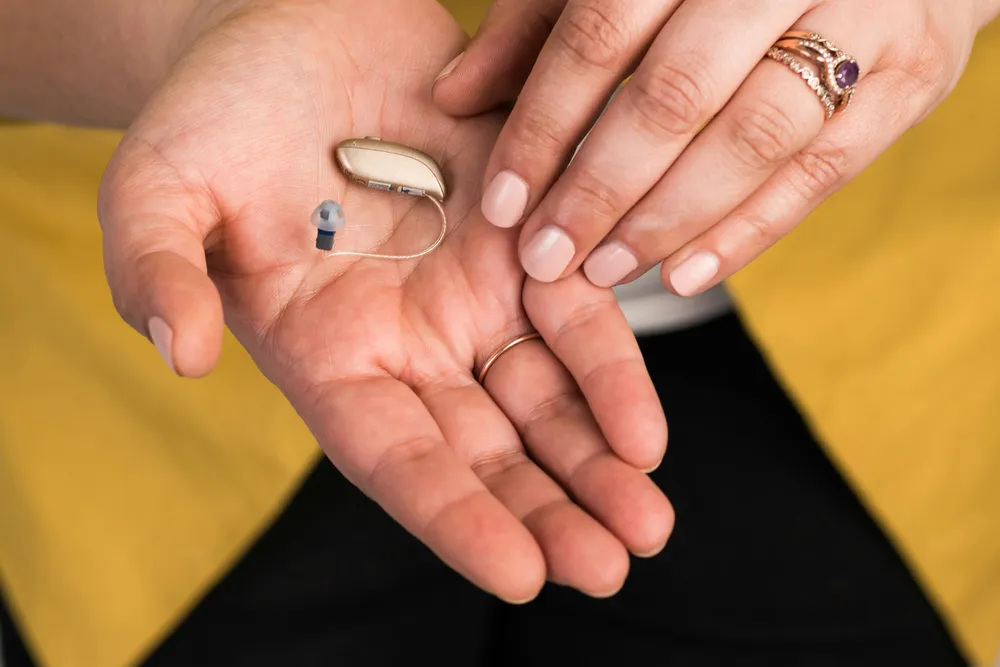
For decades, buying a hearing aid in the United States meant going through a licensed professional — an audiologist or a hearing-aid dispenser — first. In October 2022 that changed. A federal rule created an entirely new shelf category — hearing aids adults can buy the way they buy reading glasses, with no exam, no prescription, and no fitting appointment. Years on, plenty of people still aren't sure what those devices are, who they suit, or where the line falls between an over-the-counter aid and the kind an audiologist programs.
Here is the plain version.
What the rule actually did
The U.S. Food and Drug Administration published its final rule establishing over-the-counter hearing aids on August 17, 2022, and it took effect on October 17, 2022.[1] The rule created a regulatory category — it did not invent a new technology. Many OTC devices use the same digital processing found in professionally fitted aids; what changed is how you obtain them and how they are set up.
The category is defined narrowly. OTC hearing aids are intended for adults 18 and older with perceived mild to moderate hearing loss.[2] Three phrases in that sentence carry most of the weight.
Adults. The rule excludes anyone under 18. Hearing loss in children is a different clinical situation and belongs with a professional.
Perceived. The FDA deliberately kept this word rather than requiring an audiogram.[1] You do not need a measured hearing test to buy an OTC device — your own sense that you are struggling is enough. That is the point of the category, and it is also its main limitation: your perception of your hearing and a measurement of your hearing are not always the same thing.
Mild to moderate. These are audiology terms with numbers behind them. On the scale most U.S. clinicians use, a loss of 26–40 decibels of hearing level counts as mild and 41–55 as moderate; above that the labels run moderately severe, severe, and profound.[5] No consumer can feel where they sit on that scale. The only way to know is a hearing test, which is the quiet irony of a category defined by a phrase it does not require you to measure.
How OTC devices differ from prescription ones
Three practical differences matter more than the rest.
Who does the fitting. A prescription hearing aid is programmed by a licensed professional against your audiogram — the chart of what you can and can't hear at each frequency. An OTC device is self-fitted: you adjust it yourself, usually through a smartphone app that walks you through a listening exercise, or with physical controls on the device.[2]
How loud it can get. The rule caps OTC output at 111 decibels of sound pressure level, or 117 dB SPL if input-controlled compression is engaged.[1] That ceiling is the technical reason OTC devices are unsuitable for severe or profound hearing loss — they physically cannot deliver the amplification those losses require.
What comes with it. Prescription aids are usually sold alongside professional follow-up: real-ear measurement, adjustment appointments, cleaning, repairs. OTC devices are typically sold as a product, with support ranging from a well-built app to a phone number and not much else — and that support lasts only as long as the company does. In July 2026 the parent of the Eargo, Lexie, and Go Hearing brands announced a wind-down of its U.S. operations, guaranteeing customer support only through mid-September and warning that its apps would not remain available indefinitely.[6] For an app-fitted device, that can mean a hearing aid you can no longer adjust. Whichever route you take, the first month is where most of the difference between a good outcome and a drawer gets decided.
One more thing “FDA-regulated” does not mean: reviewed. Conventional OTC hearing aids — the ones you set with a dial or a few presets — fall into device classes that are exempt from FDA premarket review, so they can reach the shelf without the agency examining them.[7] Only self-fitting OTC aids, which build a profile from an in-app listening test, are in a class that requires 510(k) clearance.[8] And products that avoid the words “hearing aid” altogether — “personal sound amplifiers” and the like — are, in the FDA’s description, intended for people with normal hearing and regulated as consumer electronics, not medical devices.[9] The phrase “hearing aid” on the box is the legal tell. Our shopping guide covers what “FDA-registered” does and doesn’t mean.
What the regulation says
OTC hearing aids are intended for adults 18 and older with perceived mild to moderate hearing loss, are self-fitted by the user, and are limited to 111 dB SPL output (117 dB SPL with input-controlled compression).[1][2] Summarized from the FDA final rule and FDA consumer guidance. General information, not medical advice.
The category kept widening
The rule opened a door that manufacturers have kept walking through. In September 2024 the FDA authorized, through its De Novo pathway, the first over-the-counter hearing aid software — the Hearing Aid Feature for Apple AirPods Pro, a software-only mobile medical application intended for the same population: adults 18 and older with perceived mild to moderate hearing impairment.[3] In the supporting study of 118 subjects across several U.S. sites, people who used the self-fitting strategy reported similar perceived benefit to people who had the same device fitted by a professional, with comparable amplification measurements and comparable speech understanding in noise, and no device-related adverse events.[3] The feature now ships on AirPods Pro 2 and 3.[10] In August 2026 Samsung announced FDA clearance for an equivalent feature on its Galaxy Buds3 Pro and Buds4 Pro, due in the fourth quarter of the year[11] — the second consumer-electronics company to turn earbuds into a regulated hearing aid.
That Apple finding is worth reading carefully. It says self-fitting performed comparably for that device, in that study, in people with mild to moderate loss. It does not say self-fitting is equivalent to professional fitting in general, and it says nothing about more complex hearing loss.
The category made hearing help easier to buy. It did not make the decision of what you actually need any simpler.
Who OTC is a reasonable fit for
Broadly, the people the category was designed for: adults who notice they are asking for repeats, turning the television up past where others want it, or losing the thread in restaurants and group conversations — and whose difficulty is roughly even in both ears, gradual in onset, and not accompanied by pain, drainage, or dizziness.
It is also a reasonable fit for people who want to try something at a lower financial risk before committing to a professional fitting. OTC prices generally start well below prescription ones — a recent owner survey put the OTC average around $500 a pair against roughly $2,150 for the entry tier of prescription aids at a traditional clinic; the full picture is in what hearing aids cost and who pays — and many are sold with a return window, though, as we cover in our shopping guide, the length and terms of that window vary a great deal.[12]
When to see a professional first
The FDA lists specific signs that should send you to a doctor rather than a checkout page.[2] They include:
- Visible deformity of the ear, from birth or from injury
- Fluid, pus, or blood draining from the ear in the past six months
- Pain or discomfort in the ear
- A history of excessive earwax, or a foreign object in the ear canal
- Episodes of dizziness or vertigo
- Sudden change in hearing within the past six months, or hearing that comes and goes
- Hearing that is noticeably worse in one ear than the other
- Ringing (tinnitus) in only one ear
Worth a professional visit
Any of the signs above can point to a condition that amplification does not address and that a physician or audiologist should evaluate. Sudden hearing change in particular is treated as time-sensitive: the specialist guideline calls for evaluation within 14 days, and corticosteroid treatment, where offered, is best begun within two weeks of onset.[13] An over-the-counter device is not a substitute for that evaluation.
None of this is a reason for alarm — most age-related hearing change is gradual, common, and unremarkable. According to the National Institute on Deafness and Other Communication Disorders, about 22% of adults aged 65 to 74 and 55% of those 75 and older have disabling hearing loss.[4] It is one of the ordinary facts of getting older. The list above simply separates the ordinary version from the handful of situations where a device is the wrong first step.
The honest summary
The OTC category is a genuine expansion of access, and for adults with mild to moderate difficulty it offers a lower-cost, lower-friction way to try amplification. It is not a replacement for a hearing evaluation, it is not appropriate for children or for severe loss, and buying without a test means you are working from your own estimate of a thing that is notoriously hard to self-assess.
If you are unsure which side of that line you fall on, the cheapest useful step is not a purchase — it is a hearing test. We walk through what one involves, and what the at-home versions can and can't tell you, in our guide to the early signs of hearing loss.
Please read
General information, not medical advice. Hearing changes can have many causes — a licensed hearing professional or physician is the right person to evaluate yours. Talk to your doctor before changing any treatment or device you rely on.