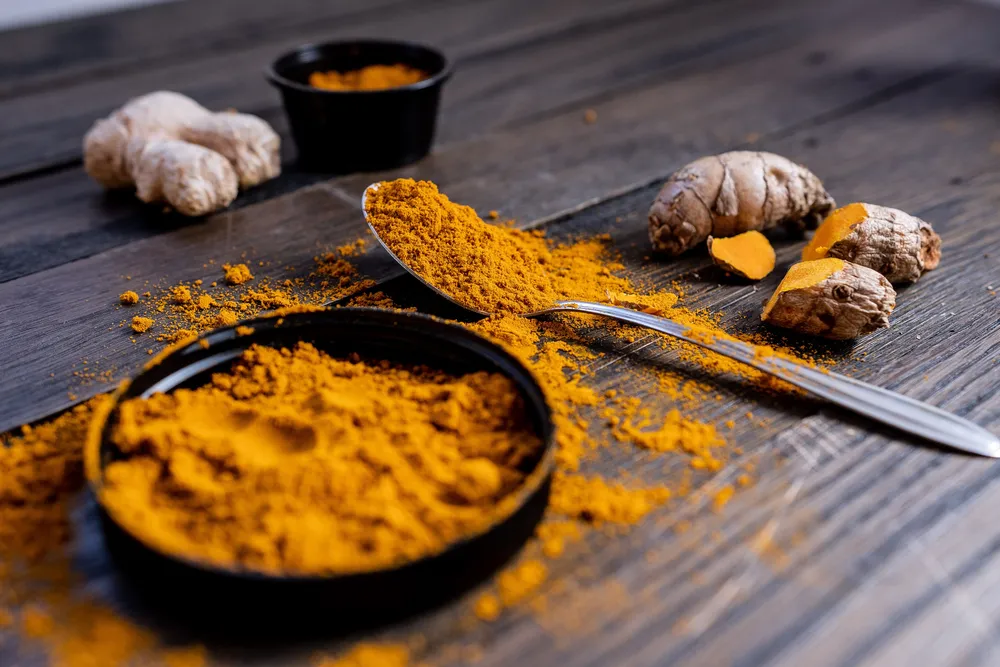
Turmeric is having a long moment. The golden spice shows up in lattes, gummies, and roughly half the joint-support products on the shelf, always with the same one-word explanation: inflammation. For once, the story isn’t built on nothing — curcumin, the family of active compounds in turmeric, has been through dozens of human trials, including for aching knees. What those trials found is worth knowing precisely. So are the three things they don’t say.
First, a number that reframes the latte: curcuminoids make up only a few percent of turmeric by weight, and the trials below used concentrated extracts — typically around 1,000 mg of curcuminoids a day. A teaspoon of spice in warm milk is a pleasant drink, not a dose. Whatever the evidence supports, it’s the extract that was tested.
What the trials found
A 2016 systematic review and meta-analysis in the Journal of Medicinal Food pooled the randomized controlled trials of turmeric extracts for arthritis symptoms and found that roughly 1,000 mg of curcuminoids a day for eight to twelve weeks was associated with meaningfully reduced pain versus placebo — and in a few small head-to-head trials against ibuprofen or diclofenac, no measurable difference in pain scores, though those trials were far too small to prove the two are equivalent.[1] The authors attached their own asterisk: the trials were small and uneven in quality, and they called for bigger, better ones rather than declaring the case closed.
A more rigorous single trial arrived in 2020 in Annals of Internal Medicine: seventy people with painful knee osteoarthritis and swelling visible on ultrasound took a standardized turmeric extract or placebo for twelve weeks. The turmeric group reported modestly less pain. But on MRI, the swelling itself — and the cartilage — looked no different between groups.[2] That’s a useful, honest result: some symptom relief, no evidence the joint itself changed. Relief is not repair, and this trial is the clearest illustration in the category. (Two footnotes, in the spirit of this article: the trial was co-funded by the University of Tasmania and by Natural Remedies, a company that makes turmeric extracts, and seventy people is small.[2])
What the research suggests
Across randomized trials, concentrated curcumin extracts (~1,000 mg/day of curcuminoids, 8–12 weeks) have been associated with modest reductions in joint pain versus placebo.[1][2] The best single trial found less pain but no measurable change in joint swelling or cartilage. Trials remain small and mixed in quality. Summarized from peer-reviewed studies. This is general information, not medical advice.
The three asterisks
Absorption. Plain curcumin passes through you mostly unabsorbed. That’s why nearly every serious product uses some enhancement trick — black-pepper extract (piperine), oil-based formulations, nanoparticles — and why products differ wildly in what actually reaches your blood. It also means the number on the label isn’t comparable across bottles, which puts turmeric in the same read-the-fine-print territory as every supplement we’ve reviewed: what form, what standardization, what was actually studied.
Study quality. Small trials with short durations and varying formulations are exactly the conditions under which a field looks better than it turns out to be. The 2016 reviewers said so themselves.[1] The pattern in this aisle is familiar: early small trials glow, the big rigorous one dims. Turmeric’s big rigorous one is still outstanding. For what it’s worth, the orthopedic surgeons’ 2021 guideline lists turmeric among supplements that “may be helpful” for mild-to-moderate knee osteoarthritis — while grading its own evidence as limited and inconsistent.[5]
The liver, rarely. Turmeric as a spice has an excellent safety record. Concentrated extracts are usually well tolerated too — but national surveillance and the NIH’s liver-injury database have logged rare cases of liver injury linked to curcumin supplements, disproportionately the enhanced-absorption kind. Cases typically show up one to four months in; the signals are the ordinary ones — unusual fatigue, nausea, dark urine, yellowing eyes — and most resolve within a few months of stopping, though a few have been severe.[3][4] Rare is the operative word — but it’s a reason the “it’s just a spice” framing doesn’t apply to high-dose extracts. One more caution from the pharmacy counter: curcumin has antiplatelet effects, and a national medicines regulator has warned of a patient whose warfarin level shot into dangerous territory within weeks of starting a turmeric product — if you take a blood thinner, that’s a conversation before the first capsule.[6]
Relief is not repair: the best trial found less pain — and a joint that looked exactly the same on the scan.
The honest bottom line
Among joint-comfort supplements, curcumin sits near the top of a modest field: real placebo-controlled trials, a plausible mechanism, effects that are probably real and probably small. If you try it, use the trial playbook — a standardized extract at a studied dose, judged over two to three months — and loop in your doctor or pharmacist first, especially if you take blood thinners or have any liver history. And keep it in its place: the interventions with far deeper evidence for aching joints — movement, strength, and weight — don’t come in a capsule.
Please read
General information, not medical advice. Supplements are not intended to diagnose, treat, cure, or prevent any disease. Talk to your doctor or pharmacist before starting one, especially alongside medication.